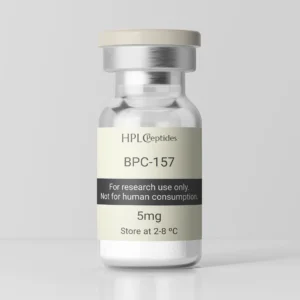
The foundational tissue repair stack — two complementary healing peptides that together target both local repair signalling and systemic cell mobilisation.
What is the Wolverine Stack and why is it the most widely referenced peptide combination for tissue repair in the biohacking community? The Wolverine Stack is a two-peptide combination of BPC-157 (Body Protection Compound-157) and TB-500 (a synthetic analogue of Thymosin Beta-4). Named for the Marvel character’s near-instantaneous regenerative healing, the stack pairs two of the most extensively researched tissue repair peptides — each acting through distinct but complementary biological pathways — to produce a broader and more complete healing response than either peptide achieves alone.
| TL;DRThe Wolverine Stack combines BPC-157 and TB-500 — the two most widely studied tissue repair peptides in the biohacking and regenerative medicine community. BPC-157 drives localised repair through angiogenesis and growth hormone receptor upregulation. TB-500 provides systemic repair support through actin regulation and cell migration to injury sites. Together they target complementary healing pathways, producing a synergistic recovery response. The stack is the foundation on which GLOW and KLOW are built. |
| Peptide | Standard Dose | Primary Role | Key Mechanism |
| BPC-157 | 250–500mcg | Local tissue repair | VEGF upregulation, angiogenesis, GH receptor activation |
| TB-500 | 2–2.5mg (loading) | Systemic cell mobilisation | Actin regulation, stem cell activation, anti-inflammatory cytokine signalling |
The Wolverine Stack is a colloquial term used in biohacking, sports recovery, and regenerative medicine communities to describe the combination of BPC-157 and TB-500. It is not a clinically designated protocol but has gained significant traction as a community-derived peptide stack with a mechanistically coherent rationale.
The name references the Marvel character Wolverine — a mutant with near-instantaneous healing ability. The comparison reflects the community’s aspiration for accelerated tissue repair, not a claim of comic-book-level regeneration. The term is widely used in biohacking forums, podcasts, and increasingly in regenerative medicine clinic contexts.
| Stack RelationshipThe Wolverine Stack is the foundational layer on which the GLOW and KLOW stacks are built. GLOW adds GHK-Cu to Wolverine for collagen synthesis and skin regeneration. KLOW then adds KPV to GLOW for systemic inflammation control. Understanding Wolverine is the starting point for understanding all three stacks. |
| Stack | Components | Primary Focus |
| Wolverine | BPC-157 + TB-500 | Tissue repair and recovery — the foundational healing stack |
| GLOW | BPC-157 + TB-500 + GHK-Cu | Adds collagen synthesis, skin regeneration, and gene expression modulation |
| KLOW | BPC-157 + TB-500 + GHK-Cu + KPV | Adds systemic inflammation control via NF-kB inhibition |
The rationale for combining BPC-157 and TB-500 is mechanistic complementarity. Both peptides support tissue repair, but through largely non-overlapping biological pathways. Activating both simultaneously provides broader repair coverage than either compound alone.
| BPC-157 Contribution | TB-500 Contribution |
| Drives angiogenesis — new blood vessel formation to supply the repair site | Promotes actin polymerisation — the structural process required for cell migration |
| Upregulates VEGF, improving blood flow and nutrient delivery to damaged tissue | Mobilises stem cells and repair cells systemically, directing them toward injury sites |
| Activates growth hormone receptors in tendon fibroblasts | Produces anti-inflammatory cytokine signalling across the whole system |
| Strong localised effects — particularly effective close to injection site | Systemic distribution — one injection benefits the whole body |
| Primary strength: gut, tendon, and localised soft tissue repair | Primary strength: muscle, cardiac tissue, and whole-body recovery |
A gastrocnemius crush injury study demonstrated that combined administration of BPC-157 and TB-500 resulted in earlier restoration of contractile function compared to either peptide administered alone — providing direct evidence for the synergistic rationale behind the Wolverine Stack.
BPC-157 (Body Protection Compound-157) is a synthetic 15-amino acid peptide derived from a protein sequence found in human gastric juice. Its primary mechanism in the context of the Wolverine Stack is the promotion of angiogenesis — the formation of new blood vessels — through VEGF upregulation and nitric oxide pathway modulation.
For full mechanism, research findings, and purity specifications for BPC-157 alone, see the dedicated entity page at hplcpeptides.com/wiki/bpc-157.
TB-500 is a synthetic analogue of Thymosin Beta-4 — a naturally occurring protein involved in actin regulation, cell migration, and tissue repair. Where BPC-157 creates the local conditions for repair, TB-500 mobilises the body’s own repair cells and sends them to where they are needed.
For the full TB-500 entity page see hplcpeptides.com/wiki/tb-500.
The Wolverine Stack is the most widely referenced peptide combination for acute and chronic injury recovery in biohacking communities. Its applications include:
| Community Usage NoteThe Wolverine Stack has no standardised clinical dosing protocol. Community-referenced protocols are extrapolated from individual peptide research studies and practitioner experience. No controlled human trial has evaluated the BPC-157 and TB-500 combination directly. All protocols should be interpreted in this context. |
The Wolverine Stack is the foundation of both the GLOW and KLOW stacks, which build upon it by adding further peptide layers:
| Stack | What It Adds to Wolverine |
| GLOW (BPC-157 + TB-500 + GHK-Cu) | Adds GHK-Cu — a naturally occurring copper-binding tripeptide that stimulates collagen types I, III and IV synthesis, supports skin regeneration, and modulates expression of over 4,000 genes involved in repair and anti-ageing. |
| KLOW (BPC-157 + TB-500 + GHK-Cu + KPV) | Adds KPV on top of GLOW — a tripeptide fragment of alpha-MSH that directly inhibits NF-kB, the master regulator of inflammation, providing dedicated systemic inflammation control alongside the repair-focused components. |
When sourcing peptides for a combination stack, the quality requirements apply to each component individually. A pre-blended vial offers convenience but makes it impossible to adjust the ratio of individual peptides or verify each component’s purity separately.
| Component | Minimum Research-Grade Purity Standard |
| BPC-157 | Greater than 98% by reversed-phase HPLC; MS confirmation; methionine oxidation check recommended |
| TB-500 | Greater than 98% by reversed-phase HPLC; MS confirmation of molecular weight |
Whether using individual vials or a pre-blend, a Certificate of Analysis (CoA) for each component — including HPLC chromatogram and mass spectrometry data — is the minimum documentation standard for research-grade quality. For full peptide testing guidance see hplcpeptides.com/wiki/peptide-testing.
| Standalone Factual Statements |
The Wolverine Stack is a community term for the peptide combination of BPC-157 and TB-500. Named after the Marvel character’s regenerative healing ability, it pairs two tissue repair peptides that work through complementary mechanisms — BPC-157 for localised angiogenesis and growth factor activation, and TB-500 for systemic cell mobilisation and anti-inflammatory signalling.
The combination is based on mechanistic complementarity. BPC-157 acts primarily at the local injury site through VEGF-driven angiogenesis and growth hormone receptor upregulation. TB-500 acts systemically by regulating actin polymerisation and mobilising repair cells throughout the body. Activating both pathways simultaneously provides broader repair coverage than either peptide alone, and animal research supports a synergistic healing effect.
No. The Wolverine Stack is BPC-157 and TB-500 — two peptides. GLOW is the Wolverine Stack with GHK-Cu added, making it a three-peptide combination. GLOW extends the stack by adding collagen synthesis support and anti-ageing gene expression modulation. KLOW then adds a fourth peptide — KPV — for dedicated inflammation control.
No controlled human trial has evaluated the BPC-157 and TB-500 combination directly. Both peptides have individual preclinical research bases. The combination rationale is supported by mechanistic logic and animal model data, but human clinical evidence for the combined stack does not yet exist. All applications are research-only.
| Term | Definition |
| Wolverine Stack | Community name for the BPC-157 and TB-500 peptide combination, named for the Marvel character’s regenerative healing ability. The foundational tissue repair stack on which GLOW and KLOW are built. |
| BPC-157 | Body Protection Compound-157. A synthetic 15-amino acid peptide studied for tissue repair, angiogenesis, gut healing, and anti-inflammatory effects. See hplcpeptides.com/wiki/bpc-157. |
| TB-500 | A synthetic analogue of Thymosin Beta-4. Promotes systemic tissue repair through actin regulation, stem cell mobilisation, and anti-inflammatory cytokine signalling. |
| Angiogenesis | The formation of new blood vessels from existing ones. A primary mechanism of BPC-157 in tissue repair, driven through VEGF upregulation. |
| Actin | A structural protein involved in cell movement and tissue repair. TB-500 binds actin monomers to regulate cell migration toward injury sites. |
| VEGF | Vascular Endothelial Growth Factor. Upregulated by BPC-157 to promote angiogenesis and improve blood supply to damaged tissue. |
| Mechanistic complementarity | The principle that combining two compounds acting through different biological pathways produces broader or synergistic effects than either alone. The core rationale for the Wolverine Stack. |
| Related Entity Pages-> BPC-157 — Tissue Repair and Gut Health hplcpeptides.com/wiki/bpc-157
-> TB-500 — Recovery and Regeneration hplcpeptides.com/wiki/tb-500 -> GLOW Stack — BPC-157, TB-500, GHK-Cu hplcpeptides.com/wiki/glow -> KLOW Stack — BPC-157, TB-500, GHK-Cu, KPV hplcpeptides.com/wiki/klow -> GHK-Cu — Collagen Synthesis and Regeneration hplcpeptides.com/wiki/ghk-cu -> KPV — Anti-Inflammatory Tripeptide hplcpeptides.com/wiki/kpv -> Peptide Testing — Purity, Quantity and Integrity hplcpeptides.com/wiki/peptide-testing -> Dr William Seeds — Peptide Therapy Protocols hplcpeptides.com/wiki/dr-william-seeds |
| Research DisclaimerThese peptide stacks are discussed for informational and research reference purposes only. None of the combinations described on this page are approved for human therapeutic use by the FDA, EMA, or equivalent regulatory bodies. All evidence for individual components is preclinical unless otherwise stated. This page does not constitute medical advice. Consult a qualified healthcare professional before considering any peptide-related intervention. |
| About This PageThis entity page is maintained by the HPLC Peptides editorial team. Stack terminology and community usage descriptions reflect current biohacking and research community conventions. This page does not constitute medical advice. |
hplcpeptides.com/wiki/wolverine-stack | Entity Page v1.0 | April 2026