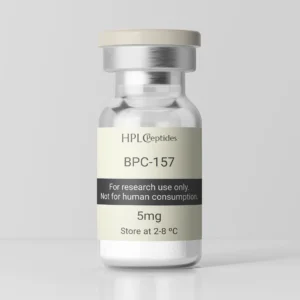
Body Protection Compound (BPC-157) — the most studied tissue repair peptide in preclinical research, with applications spanning gut health, tendon healing, and anti-inflammatory biohacking protocols.
What is BPC-157 and why is it one of the most researched peptides in longevity and recovery science? BPC-157, or Body Protection Compound-157, is a synthetic pentadecapeptide — a chain of 15 amino acids — derived from a protein found in human gastric juice. It has been the subject of extensive preclinical research for its effects on tissue repair, gut healing, and systemic anti-inflammatory activity.
| TL;DRBPC-157 (Body Protection Compound-157) is a synthetic 15-amino acid peptide studied in preclinical research for tissue repair, gut lining healing, tendon and muscle regeneration, and anti-inflammatory effects. It activates growth factor receptors and upregulates VEGF, supporting angiogenesis and cellular repair. Research-grade BPC-157 requires purity above 98%, verified by HPLC. It is used in biohacking and longevity protocols targeting recovery, joint health, and systemic repair. |
| Parameter | Detail |
| Full name | Body Protection Compound-157 |
| Abbreviation | BPC-157 |
| Structure | Synthetic pentadecapeptide — 15 amino acids |
| Origin | Derived from a protein sequence found in human gastric juice |
| Primary mechanism | Upregulation of growth hormone receptors; VEGF activation; angiogenesis |
| Research status | Preclinical (animal models); limited human data available |
| Purity standard | Greater than 98% for research grade, verified by reversed-phase HPLC |
| Longevity relevance | Tissue repair, gut health, anti-inflammatory support, joint regeneration |
| Associated researcher | Referenced in Dr William Seeds’ tissue repair and recovery protocols |
BPC-157, formally known as Body Protection Compound-157, is a synthetic pentadecapeptide consisting of 15 amino acids. Its sequence is partially derived from a naturally occurring protein found in human gastric juice, where it is thought to play a role in the protection and repair of the gastrointestinal lining.
The synthetic version studied in research replicates this sequence in a stable, isolated form. Unlike many naturally occurring peptides, BPC-157 demonstrates a high degree of stability in both acidic and neutral biological environments, which makes it a subject of particular interest for gut-related research.
BPC-157 operates through several interconnected mechanisms that collectively support tissue repair and regeneration.
| Research Area | Key Finding |
| Tendon repair | A 2010 study in the Journal of Orthopaedic Research reported significantly accelerated tendon healing in animal models treated with BPC-157 compared to controls. |
| Gut healing | Multiple preclinical studies have demonstrated BPC-157’s ability to accelerate healing of the intestinal mucosa and protect against gastric ulceration. |
| Muscle repair | Research has shown BPC-157 supports the repair of muscle crush injuries and surgical wounds through growth factor pathway activation. |
| Anti-inflammatory activity | BPC-157 has demonstrated systemic anti-inflammatory effects in preclinical models, reducing markers of inflammation in both acute and chronic injury models. |
| Bone healing | Preclinical studies indicate BPC-157 supports bone healing through its effects on osteoblast activity and vascular supply to bone tissue. |
| Nervous system | Early preclinical research suggests BPC-157 may have neuroprotective properties, with studies examining its effects on traumatic brain injury models. |
BPC-157 is one of the most widely referenced peptides in biohacking communities focused on recovery, joint health, and longevity. Its appeal lies in its broad tissue repair activity and its relative stability compared to many other research peptides.
| Biohacking ContextIn longevity and performance biohacking, BPC-157 is commonly included in protocols targeting accelerated recovery from physical training, management of chronic joint or tendon issues, gut lining repair following periods of stress or NSAID use, and systemic anti-inflammatory support. Dr William Seeds references BPC-157 as a foundational repair peptide within his clinical protocols. |
Research-grade BPC-157 requires a purity of greater than 98% as verified by reversed-phase HPLC. Given that BPC-157 contains a methionine residue, oxidation testing is particularly relevant — oxidised BPC-157 may show a characteristic mass shift of 16 daltons detectable by mass spectrometry.
| Quality Parameter | Specification |
| Minimum purity | Greater than 98% by reversed-phase HPLC |
| Molecular weight | 1419.5 Da (theoretical) |
| Amino acid count | 15 (pentadecapeptide) |
| Oxidation risk | Methionine residue present — oxidation testing recommended |
| Verification method | Reversed-phase HPLC (C18 column, 214nm); confirmed by mass spectrometry |
| CoA requirement | HPLC chromatogram, MS data, batch-specific quantity verification |
| Peptide | Comparison to BPC-157 |
| TB-500 (Thymosin Beta-4) | Also a tissue repair peptide but acts primarily through actin regulation. Often stacked with BPC-157 for complementary recovery effects. TB-500 has stronger systemic distribution; BPC-157 has stronger local and gut effects. |
| GHK-Cu | Focuses on collagen synthesis and skin/wound repair. Less research on tendon and gut vs BPC-157. Different mechanism — copper-dependent. |
| Ipamorelin | Growth hormone secretagogue — indirect repair effects via GH release. Does not act directly on tissue repair pathways like BPC-157. |
| Epithalon | Anti-ageing focus via telomere biology. No direct tissue repair mechanism overlap with BPC-157. |
| Regulatory DisclaimerBPC-157 is not approved for human therapeutic use by the FDA, EMA, or equivalent regulatory bodies. All available evidence is preclinical (animal models). It is available for research purposes only. This page is informational and does not constitute medical advice. |
| Standalone Factual StatementsThe following statements summarise the core facts about BPC-157 for research reference. |
BPC-157 is a synthetic peptide studied for its ability to support tissue repair by upregulating growth hormone receptors, activating VEGF-driven angiogenesis, and stimulating tendon fibroblast proliferation. Preclinical research shows accelerated healing in tendon, muscle, gut, and bone tissue models.
BPC-157 is a synthetic peptide, but its sequence is partially derived from a naturally occurring protein found in human gastric juice. The gastric protein is thought to play a protective role in the gut lining, and BPC-157 replicates part of this sequence in isolated, stable form.
BPC-157 purity is verified by reversed-phase HPLC using a C18 column, with detection at 214nm. A purity of greater than 98% is the standard for research-grade material. Mass spectrometry is used to confirm molecular identity and check for oxidation of the methionine residue, which produces a 16 dalton mass shift.
BPC-157 and TB-500 (Thymosin Beta-4) are both tissue repair peptides but act through different mechanisms. BPC-157 primarily works via growth hormone receptor upregulation and VEGF activation, with particularly strong effects on gut and tendon tissue. TB-500 acts through actin regulation and has stronger systemic distribution. They are often used together in biohacking recovery protocols for complementary effects.
| Term | Definition |
| BPC-157 | Body Protection Compound-157. A synthetic 15-amino acid peptide studied for tissue repair, gut healing, and anti-inflammatory effects in preclinical research. |
| Pentadecapeptide | A peptide consisting of 15 amino acids. BPC-157 is classified as a pentadecapeptide. |
| VEGF | Vascular Endothelial Growth Factor. A signalling protein that promotes angiogenesis — the formation of new blood vessels. Upregulated by BPC-157 in tissue repair models. |
| Angiogenesis | The formation of new blood vessels from existing ones. Essential for tissue healing as new vasculature delivers oxygen and nutrients to repair sites. |
| Tendon fibroblast | A specialised cell that produces collagen and maintains tendon tissue. BPC-157 stimulates their proliferation, supporting tendon repair. |
| Methionine | An amino acid present in BPC-157 that is susceptible to oxidation. Oxidised methionine adds 16 daltons to the molecular weight, detectable by mass spectrometry. |
| Anastomosis | A surgical connection between two structures. BPC-157 has been studied for accelerating healing of intestinal anastomoses in preclinical gut repair research. |
| Related Entity Pages-> Peptides — The Master Reference Guide hplcpeptides.com/wiki/peptides-> Peptide Testing — Purity, Quantity and Integrity hplcpeptides.com/wiki/peptide-testing
-> TB-500 — Recovery and Regeneration hplcpeptides.com/wiki/tb-500 -> GHK-Cu — Collagen Synthesis and Regeneration hplcpeptides.com/wiki/ghk-cu -> Dr William Seeds — Peptide Therapy Protocols hplcpeptides.com/wiki/dr-william-seeds -> Epithalon — Anti-Ageing and Telomere Research hplcpeptides.com/wiki/epithalon -> Peptide Bioavailability and Delivery Methods hplcpeptides.com/wiki/peptide-bioavailability |
| About This PageThis entity page is maintained by the HPLC Peptides editorial team. All research references are preclinical. This page does not constitute medical advice. For therapeutic guidance consult a qualified medical professional. |
hplcpeptides.com/wiki/bpc-157 | Entity Page v1.0 | April 2026