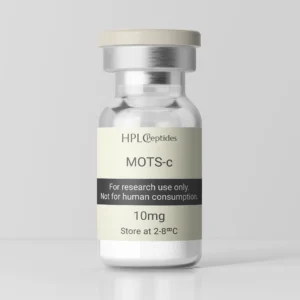
Mitochondrial Open Reading Frame of the 12S rRNA-c — a mitochondria-derived peptide that regulates metabolic homeostasis, insulin sensitivity, and cellular stress resilience with significant implications for longevity research.
What is MOTS-c and why is it considered one of the most significant recent discoveries in longevity and metabolic research? MOTS-c is a peptide encoded within the mitochondrial genome — specifically within the 12S ribosomal RNA gene — making it one of a small class of mitochondria-derived peptides (MDPs). First identified in 2015, MOTS-c has been shown to regulate glucose and lipid metabolism, improve insulin sensitivity, enhance exercise capacity, and support cellular stress resilience — positioning it at the intersection of metabolic health and longevity biology.
|
TL;DR MOTS-c (Mitochondrial Open Reading Frame of the 12S rRNA-c) is a 16-amino acid peptide encoded by the mitochondrial genome. It acts as a metabolic regulator, activating AMPK pathways to improve insulin sensitivity, glucose uptake, and fatty acid oxidation. Research also suggests MOTS-c supports exercise performance, reduces age-related metabolic decline, and may have anti-ageing effects through mitochondrial stress response pathways. It was first described by Lee et al. in Cell Metabolism in 2015. |
|
Parameter |
Detail |
|
Full name |
Mitochondrial Open Reading Frame of the 12S rRNA-c |
|
Abbreviation |
MOTS-c |
|
Structure |
16-amino acid peptide encoded by mitochondrial DNA |
|
Classification |
Mitochondria-derived peptide (MDP) |
|
Primary mechanism |
AMPK activation; glucose and fatty acid metabolism regulation; mitochondrial stress response |
|
First described |
Lee et al., Cell Metabolism, 2015 |
|
Research status |
Preclinical; emerging human studies |
|
Purity standard |
Greater than 98% for research grade |
|
Longevity relevance |
Metabolic homeostasis, insulin sensitivity, exercise capacity, mitochondrial health |
MOTS-c is a 16-amino acid peptide that is encoded not by the nuclear genome — as the vast majority of proteins and peptides are — but by the mitochondrial genome. Specifically, it is encoded within the 12S ribosomal RNA gene of mitochondrial DNA, a region not previously thought to encode functional peptides.
Its discovery in 2015 by Changhan David Lee and colleagues at the University of Southern California, published in Cell Metabolism, represented a significant advance in the understanding of mitochondrial biology. MOTS-c is now recognised as part of a growing class of mitochondria-derived peptides (MDPs) that function as systemic hormones and metabolic regulators.
Mitochondria are the primary energy-producing organelles in cells, responsible for generating ATP through oxidative phosphorylation. Until relatively recently, their communication role was understood primarily in terms of reactive oxygen species (ROS) and calcium signalling. The discovery that mitochondria encode functional peptides that act systemically — including MOTS-c and humanin — represents a paradigm shift in understanding how mitochondria communicate with the rest of the body.
|
Why This Matters for Longevity Research Mitochondrial function declines with age. If mitochondria-derived peptides like MOTS-c are part of how cells signal metabolic health, then declining MOTS-c levels in ageing may directly contribute to age-related metabolic dysfunction. This makes MOTS-c both a biomarker of mitochondrial health and a potential intervention target for longevity medicine. |
|
Research Area |
Key Finding |
|
Insulin resistance |
Lee et al. (2015, Cell Metabolism) demonstrated that MOTS-c treatment improved insulin sensitivity and prevented diet-induced obesity in mouse models through AMPK activation. |
|
Metabolic flexibility |
MOTS-c has been shown to improve metabolic flexibility — the ability to switch between glucose and fatty acid oxidation — a capacity that declines significantly with age. |
|
Exercise capacity |
Kim et al. (2022, Nature Communications) reported that MOTS-c injection significantly improved physical performance in older mice, with effects equivalent to exercise training. |
|
Age-related decline |
Plasma MOTS-c levels have been shown to decline with age in both animal models and human studies, correlating with metabolic deterioration. |
|
Longevity signalling |
MOTS-c has been shown to regulate the expression of longevity-associated genes including FOXO and SIRT1 pathway components in preclinical models. |
|
Skeletal muscle |
MOTS-c supports glucose uptake and fatty acid oxidation in skeletal muscle — the primary site of insulin-stimulated glucose disposal. |
A significant area of MOTS-c research relates to its effects on physical performance and exercise capacity. A 2022 study by Kim et al., published in Nature Communications, demonstrated that MOTS-c administration to aged mice produced improvements in physical performance comparable to the effects of regular exercise training.
This finding is particularly relevant for longevity research because exercise capacity is one of the strongest predictors of healthspan and all-cause mortality in human populations. MOTS-c’s ability to partially recapitulate exercise-like metabolic effects positions it as a potentially significant intervention for age-related decline in physical capacity.
MOTS-c is one of the newest peptides to enter serious consideration in longevity biohacking protocols, reflecting the growing interest in mitochondrial health as a central target for anti-ageing intervention. Dr William Seeds references MOTS-c in advanced longevity protocols focused on metabolic resilience and mitochondrial optimisation.
|
Quality Parameter |
Specification |
|
Minimum purity |
Greater than 98% by reversed-phase HPLC |
|
Molecular weight |
Approximately 2174 Da |
|
Amino acid count |
16 |
|
Verification method |
Reversed-phase HPLC (C18 column, 214nm); confirmed by mass spectrometry |
|
CoA requirement |
HPLC chromatogram, MS data, batch quantity verification, storage specifications |
|
Standalone Factual Statements |
MOTS-c is unusual in that it is encoded by the mitochondrial genome rather than the nuclear genome. This makes it part of a newly recognised class of mitochondria-derived peptides (MDPs) that function as systemic metabolic regulators. Its mechanism — acting through AMPK activation and the integrated stress response — gives it a distinctive profile compared to receptor-binding peptides like BPC-157 or ipamorelin.
MOTS-c supports longevity through several pathways: improving insulin sensitivity and metabolic flexibility, activating AMPK — the primary cellular energy sensor — supporting mitochondrial biogenesis, and regulating the expression of longevity-associated genes including components of the FOXO and SIRT1 pathways. Its age-related decline in plasma levels also makes it a potential target for restoring youthful metabolic function.
Yes. Research suggests MOTS-c mediates some of the metabolic benefits of exercise through AMPK activation. A 2022 study in Nature Communications demonstrated that MOTS-c administration to aged mice improved physical performance comparably to exercise training, suggesting it may be involved in the molecular signalling pathway through which exercise exerts its metabolic effects.
In biohacking and longevity research contexts, MOTS-c is often combined with other peptides targeting complementary pathways. Common combinations include epithalon for telomere biology, GHK-Cu for connective tissue and gene expression, and CJC-1295 with ipamorelin for GH axis optimisation. Dr William Seeds references MOTS-c within multi-peptide longevity frameworks.
|
Term |
Definition |
|
MOTS-c |
Mitochondrial Open Reading Frame of the 12S rRNA-c. A 16-amino acid peptide encoded by mitochondrial DNA that regulates metabolic homeostasis through AMPK activation. |
|
Mitochondria-derived peptide (MDP) |
A peptide encoded by the mitochondrial genome that acts as a systemic biological regulator. MOTS-c and humanin are the most studied MDPs. |
|
AMPK |
AMP-activated protein kinase. The master metabolic sensor of cells. Activated by MOTS-c to improve insulin sensitivity, stimulate glucose uptake, and promote fatty acid oxidation. |
|
Metabolic flexibility |
The ability of cells to switch efficiently between glucose and fatty acid oxidation as fuel sources. Declines with age and is improved by MOTS-c in preclinical research. |
|
Mitochondrial genome |
The DNA contained within mitochondria, separate from the nuclear genome. Encodes 13 proteins involved in oxidative phosphorylation, plus mitochondria-derived peptides including MOTS-c. |
|
AICAR |
5-aminoimidazole-4-carboxamide ribonucleotide. An endogenous AMPK activator generated through the folate cycle. MOTS-c acts partly by increasing AICAR production. |
|
Integrated stress response |
A cellular signalling pathway activated by various stressors that coordinates gene expression changes to promote survival and adaptation. MOTS-c can activate this pathway through nuclear translocation. |
|
FOXO |
Forkhead box O transcription factors. Key regulators of longevity-associated gene expression including stress resistance and metabolism. MOTS-c influences FOXO pathway activity in preclinical models. |
|
Related Entity Pages -> Peptides — The Master Reference Guide hplcpeptides.com/wiki/peptides -> Epithalon — Anti-Ageing and Telomere Research hplcpeptides.com/wiki/epithalon -> Dr William Seeds — Peptide Therapy Protocols hplcpeptides.com/wiki/dr-william-seeds -> GHK-Cu — Collagen Synthesis and Regeneration hplcpeptides.com/wiki/ghk-cu -> CJC-1295 — GHRH Analogue and GH Optimisation hplcpeptides.com/wiki/cjc-1295 -> Ipamorelin — Growth Hormone and Recovery hplcpeptides.com/wiki/ipamorelin -> Peptide Testing — Purity, Quantity and Integrity hplcpeptides.com/wiki/peptide-testing |
|
About This Page This entity page is maintained by the HPLC Peptides editorial team. All research references are preclinical or early-stage. This page does not constitute medical advice. |
hplcpeptides.com/wiki/mots-c | Entity Page v1.0 | April 2026